
Why this exists
Manual QA is inconsistent by nature
Right now there is a QA process somewhere in your operation. A second reader. A coordinator with a checklist. A pass before reports go out. It costs time, it costs money, and it still misses things.
Not because nobody was trying. The errors that reach your clients did not slip through by accident. They slipped through because no human process catches everything, every time, on every report, at 2am as reliably as at 10am.
Skia does not get tired, distracted, or behind on volume. It applies the same checks to the first report of the day and the four hundredth.
How it works
A quality gate that is always on
It runs on every report
Not a weekly sample, not a second reader for the high-risk cases. Every report your team produces is reviewed the same way, every time.
It checks before submit
The review happens while the report is being finalized, in seconds. Issues are caught before the report leaves, not after a hospital client calls back.
The radiologist sees the flags
Problems show up inline for the person who can fix them fastest. Fix once, submit clean. Most flags are resolved in the moment, without a single email.
You get told what matters
QA flags and critical findings can notify you and your team, so you have visibility without reading behind every radiologist.
What Skia checks
The checks a tired reader misses
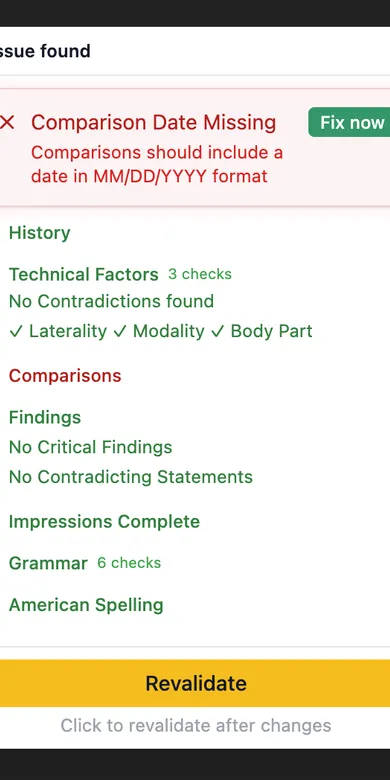
Every report is read against the same set of clinical consistency rules. Here is what that covers today, and the list keeps growing.
-
Comparison dates
Flags a missing prior, the wrong prior, or a comparison date that does not match the study being read.
-
Laterality
Catches a right finding written into a left section, or sides that contradict between findings and impression.
-
Internal contradictions
Surfaces statements that disagree with each other inside the same report before they reach a clinician.
-
History and technique
Checks that the clinical history and technical factors are present and consistent with the findings.
-
Findings and impression
Confirms the impression actually reflects the findings, with nothing significant left unaddressed.
-
Critical findings
Highlights findings that need to be communicated, so nothing urgent leaves quietly buried in the body.
-
Grammar and spelling
Cleans the language errors that make a report read as rushed, without changing its meaning.
-
Completeness
Verifies every required section is filled in for the modality and body part being reported.
What changes for you
You stop being the last line of defense
Fewer callbacks
The errors that trigger a client call get caught before submit, so they never become your problem to apologize for.
QA you can scale
Volume can double without doubling the people you pay to re-read reports that were already fine.
A defensible standard
Every report passed through the same checks. Consistency you can point to, not hope for.
See it running on your own reports
No setup fees, no IT project, no training required. Most teams are live within 48 hours.
Book a Demo